
You’re looking at $92,000–$98,000 as the national full-time average, but your industry choice reshapes everything. Mining hands you $60.60 per hour, while hospitality stalls at $25.90—that’s more than double for picking the right sector. Tech specialists in Sydney pull $149,000, Western Australian mine managers clear $300,000, and cybersecurity designers can reach $340,000.
Your location matters too: Perth delivers mining premiums, Sydney rewards finance and tech, and Brisbane balances moderate pay with lower living costs.
Whether you negotiate alone or through collective agreements, your bargaining power and sector strategy determine where you land in these sharply divergent pay sceneries—and the next sections break down exactly how to position yourself for the top tier?
TLDR
- Mining leads hourly pay at $60.60, with registered mine managers earning around $300,000 annually.
- Tech professionals command $70,000–$250,000, with software engineers averaging $149,000 in Sydney.
- Healthcare specialists and cybersecurity designers earn $200,000–$340,000 due to critical shortages.
- Engineering and construction managers reach $155,000–$260,000 depending on location and experience.
- Executive, legal, and C-suite roles exceed $375,000, reflecting strategic organisational responsibilities.
What Australians Actually Earn: National Salary Averages for 2026

Whether you’re planning your next career move or simply curious about where you stand, understanding what Australians actually earn in 2026 gives you real knowledge into today’s job market.
You’ll find full-time workers averaging $92,000–$98,000 annually, with weekly earnings at $2,051.10.
Your take-home pay typically reaches $5,300–$5,700 monthly after deductions.
Wages grew 3.8% this year—how does your salary compare to these benchmarks?
Keep in mind that this average figure is pulled upward by high-income earners, while the median Australian salary sits notably lower at $74,672 annually, representing the true middle point where half of all workers earn more and half earn less.
The labour market remains strong with unemployment at 4.2% and high job vacancies sustaining demand for workers.
Know what you’re worth — now make sure your resume proves it. A professionally written resume helps you negotiate from a position of strength.
How Your Pay Gets Set: Negotiating Alone vs. Collective Agreements
You know what Australians typically earn, but do you understand why your specific pay packet looks the way it does?
If you negotiate alone through individual arrangements—now covering 38.7% of contracts—you control your salary talks directly with your employer, leveraging skills and flexibility for bonuses or benefits, yet outcomes vary widely based on your bargaining power and their retention needs.
Contracting can also lead to higher weekly earnings for some roles, especially in AI and cybersecurity, reflecting strong market demand.
Tech Salaries in Australia: Software Engineers, Data Scientists, and Cybersecurity Pay

You’re probably wondering what you can actually earn in Australia’s tech sector, and the numbers might surprise you—software engineers in Sydney pull in median total compensation around A$149,000 according to Levels.fyi, while data scientists and cybersecurity specialists are commanding even higher premiums as AI adoption and security risks reshape the market.
Whether you’re just starting out at A$70,000–A$90,000 or eyeing senior roles that crack A$150,000–A$250,000, your location and specialization will heavily influence where you land on the pay scale.
Always obtain written permission from referees to comply with Australian privacy laws and protect their time and trust by getting signed consent.
Salary Ranges
Discover Australia’s tech salary scenery, and you’ll find that software engineers, data scientists, and cybersecurity professionals are commanding impressive compensation packages in 2026.
As a software engineer, you can expect to earn between A$113,034 and A$186,487 depending on your experience, with entry-level roles starting around A$60,000 and senior positions reaching A$250,000.
Where will your skills take you?
Demand Trends
Why are Australian employers scrambling to secure tech talent faster than almost anywhere else on the planet?
You’ll find Australia’s tech hiring rate hit 32% in 2025, surpassing the global 29% average, as digital alteration, AI integration, and cloud migration create unceasing demand.
Whether you’re a software engineer, data scientist, or cybersecurity specialist, your skills are desperately needed, with niche proficiency commanding premium salaries and strong competition for leadership roles across this rapidly expanding sector.
Engineering and Construction Earnings: Civil, Mechanical, and Site Manager Rates
As you map out your career path in Australia’s engineering and construction sectors, you’ll find that salary ranges vary dramatically based on your specialization, experience level, and whether you’re working in design, site management, or executive leadership roles.
Have you considered how construction manager premiums can push your earnings well beyond standard engineering rates, with top-tier positions commanding $250,000 to $320,000 annually?
Whether you’re starting as a graduate civil engineer at around $95,000 or aiming for principal positions exceeding $200,000, understanding these pay structures will help you negotiate confidently and target the right opportunities for your financial goals.
Financial controllers also play a key role in maintaining organisational financial health and advising on strategic decisions, making internal controls and financial reporting essential considerations for construction firms.
Engineering Salary Ranges
Whether you’re fresh out of university or evaluating your next career move, understanding where your engineering salary could land puts you in control of your professional future, doesn’t it?
You’ll earn AU$65,000–$80,000 as an entry-level mechanical engineer, progressing to AU$120,000–$150,000+ with 10+ years.
Civil engineers follow similar paths, reaching AU$130,000–$175,000+ at senior levels.
Site managers command AU$155,466 on average, with Gold Coast roles offering AU$188,261.
Your skill directly shapes your earning potential, so which direction will you pursue?
Construction Manager Premiums
You’ve seen how engineering salaries climb with experience, but what happens when you step into the driver’s seat of an entire construction project? As a construction manager, you’re looking at $160,000 to $185,000 nationally, though civil roles in Melbourne can reach $260,000 when you serve complex infrastructure needs.
Your leadership directly impacts communities, and Tier 1 contractors reward that responsibility handsomely.
Mining Industry Wages: Why Western Australia Pays the Most
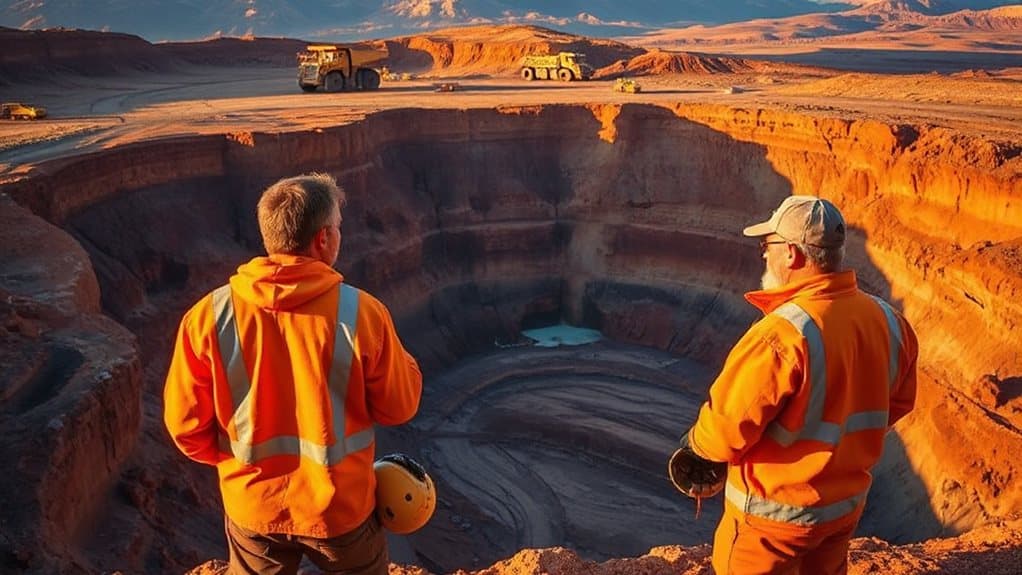
If you’re considering up where to launch or advance your mining career, you’ll want to pay close attention to Western Australia, because this state consistently outpaces the rest of the country when it comes to your pay packet.
As a registered mine manager, you’d earn roughly $300,000 annually, which is $30,000 more than New South Wales and nearly $100,000 above Victoria.
Your skills in technical roles command strong premiums too, with chief geologists receiving about $250,000 and geotechnical engineers pocketing $190,000.
Even as an excavator operator, you’d take home around $175,000, which beats other states by $30,000.
Why does WA reward you so generously? The state’s concentration of large-scale iron ore, gold, and metalliferous operations, combined with remote FIFO sites and harsh conditions, creates intense compensation pressure.
Skills shortages in your field keep pushing wages upward, with some professions now exceeding previous boom-era levels.
Whether you’re starting out or climbing higher, WA offers you unmatched earning potential across every mining tier. Many employers also require current Standard 11 and fitness documentation as part of hiring, so ensure your certifications are up to date.
Know what you’re worth — now make sure your resume proves it. A professionally written resume helps you negotiate from a position of strength.
How Location Changes Your Salary: Sydney, Perth, Melbourne, and Brisbane Compared
Your paycheck looks different depending on which city you call home, and that’s something you’ll want to factor into your career planning.
Sydney leads with premium salaries in finance and tech, often exceeding national averages, while Melbourne offers strong pay with more variation across industries.
You’ll find Brisbane provides solid, moderate earnings with lower living costs, and Perth delivers excellent wages in mining, engineering, and technical roles where your skills truly shine.
Which Industries Pay the Highest Hourly Rates in Australia?

Where exactly should you focus your career search if you’re aiming for the strongest hourly pay in Australia? Mining leads at $60.60 per hour, followed by finance, utilities, and professional services.
You’ll find these industries reward specialised skills and technical proficiency.
Accommodation and food services pay the least at $25.90, so choose your sector wisely to maximise your earning potential.
Where Demand Still Outstrips Supply: Australia’s Most Secure High-Paying Jobs
Although Australia’s job market shifts constantly, you’ll find genuine stability when you target roles where qualified candidates simply aren’t keeping pace with employer needs.
Healthcare specialists—psychiatrists, cardiologists, rural dentists—serve communities while earning $200,000+.
Mining leaders overseeing crews and automation reach $300,000-$500,000.
Cybersecurity designers protecting critical infrastructure command $340,000.
C-suite executives, general counsel, and CIOs drive organisational strategy with packages exceeding $375,000.
Where will your skills meet Australia’s deepest needs?
And Finally
You’ve seen how industry, location, and negotiation shape what you can earn across Australia’s workforce, so now you’re equipped to make smarter career moves. Whether you’re drawn to tech, mining, or healthcare, you know where demand runs highest and pay follows suit. Will you use this knowledge to negotiate your next role, or investigate a sector where your skills command premium rates? Your next step starts with the confidence you’ve just gained.

Emma Anderson is a professional executive resume and creative writer. She founded JobFrog Resumes in 2015 after leaving full-time work to raise her first child, combining her two passions: working from home with her family, and helping people put their best selves forward on paper. Emma has personally written every JobFrog resume since — no outsourcing, no templates — and stands behind the Jobfrog Rewrite Guarantee.