
Yes, Australian employers can absolutely check your education, and they’ll need your written consent first under the Privacy Act 1988. They’ll contact your schools directly to verify degrees, diplomas, and attendance dates, which typically takes about one week to complete. You’re free to refuse, though this might hurt your chances if the role requires specific credentials, especially in regulated fields like healthcare or childcare. Smart candidates gather their transcripts, certificates, and photo ID before applying, since being prepared shows professionalism and speeds up the process. Want to know exactly how they conduct these checks and what you can do if something doesn’t match up?
TLDR
- Australian employers can verify education with your written consent under the Privacy Act 1988.
- Verification typically takes one week and involves contacting institutions directly.
- Candidates may refuse verification, though this may affect prospects in credential-dependent roles.
- Healthcare and childcare sectors require mandatory education verification by law.
- Original transcripts, certified certificates, and photo ID are needed for smooth verification.
Can Australian Employers Legally Verify Your Education?

How often have you wondered whether your potential employer can dig into your academic history before offering you that dream job? You’re in luck—Australian employers absolutely can verify your education, provided you’ve given your written consent. This practice helps organizations protect their teams and clients by ensuring you’ve got the genuine qualifications needed to serve others safely and effectively. Employers must obtain written permission from you before contacting institutions or sharing referee information.
Employers typically complete this verification by contacting educational institutions directly to confirm your degrees, diplomas, or certifications, with the entire process usually taking around one week to finalize.
What Privacy Law Requires Before Any Check Begins
Before you hand over your academic records to a potential employer, it’s worth understanding exactly what privacy laws demand from both you and the organizations involved. Under Australia’s Privacy Act 1988, your consent is mandatory before any collection or disclosure occurs. Schools must notify you of their collection purposes, and employers can’t access your records without your written permission—protecting your sensitive information remains their legal obligation, not just a courtesy. Tailor your resume by emphasizing education details such as degrees, GPA, relevant courses, and certifications to demonstrate readiness and align your background with the role.
Can You Refuse an Education Check and Still Get Hired?

Where exactly does the law stand when you’re asked to hand over your academic records, and can you push back without losing your shot at the job?
Under Australia’s Privacy Act 1988, you hold the right to refuse education verification, and employers can’t automatically disqualify you, though your prospects depend heavily on the role you’re pursuing.
In non-regulated positions, refusal typically proceeds without penalty, as many employers accept statutory declarations or reference checks instead, but sensitive sectors like childcare or healthcare mandate verification under compliance laws, meaning refusal automatically disqualines you from those opportunities.
Your refusal won’t trigger anti-discrimination protections if the job genuinely requires proven credentials, so weigh your choice carefully against the position’s demands and consider alternatives like skill assessments that demonstrate your capabilities without formal institutional confirmation.
Remember that many Australian employers use ATS to screen applications, so tailor other parts of your application to highlight verifiable skills and achievements.
How Employers Actually Verify Your Academic Credentials
Ever wondered what actually happens after you click “submit” on that job application and your academic credentials vanish into the hiring pipeline? Employers request your transcripts, certificates, and proof of identity, then check if your institution is accredited. They contact your school directly, use digital tools like My eQuals, and sometimes hire specialized agencies to verify every detail thoroughly. Recruiters also often prioritise concise, relevant documentation to speed up checks and fit typical short review windows, especially for early-career applicants resume length.
What Records Employers Can and Can’t Verify

How much do you really know about what employers can actually dig up from your academic past, and where do privacy laws draw the line? You can verify degrees, certificates, and attendance dates directly with institutions, plus check transcripts through document verification services. However, you can’t access pre-2015 training records without contacting the original RTO, and there’s no central register for all qualifications. Investing in a professionally written, ATS-optimised resume can help ensure your verified qualifications are presented effectively alongside your achievements, increasing visibility to employers and recruiters (ATS optimisation).
Which Industries Demand Stricter Education Checks
You’ll find that certain industries in Australia enforce far more rigorous education verification than others, particularly when public safety or financial integrity hangs in the balance. If you’re pursuing work in healthcare, you’ll need to prove your medical or nursing qualifications through official channels before you can even apply for mandatory professional licenses.
Are you considering roles involving children or sensitive financial responsibilities? Then you should prepare for thorough background screening that scrutinizes every credential, because employers in these sectors face strict regulatory obligations they simply can’t ignore.
Healthcare Licensing Requirements
If you’re considering a career in Australia’s healthcare sector, you’ll quickly uncover that education verification isn’t just a formality—it’s a rigorous, multi-layered process designed to protect patient safety and maintain professional standards.
You’ll need primary source verification through ECFMG as an international medical graduate, and your diploma must be checked directly with your university.
For nursing, ANMAC accreditation is mandatory, and you must maintain this throughout your registration period.
Have you confirmed your credentials meet these strict requirements?
Child Safety Screening
Wherever you’re hoping to work with kids in Australia—whether that’s in a classroom, a childcare centre, or even behind the scenes in administration—you’re going to face some of the strictest education and screening requirements in the country, and there’s no way around it. You’ll need a Working with Children Check, plus mandatory child safety training by February 2026. Are you prepared to meet these deadlines?
Financial Services Standards
Child safety screening sets a high bar for anyone working with vulnerable young people, but it’s far from the only field where your educational credentials face intense scrutiny. If you’re pursuing financial advice, you’ll need a bachelor’s degree or higher that matches ASIC’s exact standards, including specific course codes and bridging units like Ethics and Professionalism. Your employer must verify your transcript directly with your education provider, checking it against Schedule 1 of the 2021 Determination, and you’ll need to pass the financial adviser exam before completing your professional year. Are you prepared to meet these rigorous requirements by the 2026 deadline?
Why Overseas Degrees Trigger Deeper Verification Steps
Why do employers scrutinise your overseas qualifications more closely than domestic ones? You’re asking institutions to verify documents across borders, where shady operations mimic reputable names.
They’ll check TEQSA registration for Australian equivalents, assess your credentials against our Qualifications Framework, and sometimes require bridging courses. Your patience helps them protect workplace standards while recognising your genuine achievements.
What Happens When Your Credentials Don’t Match Your Claims

Overseas qualifications might get extra attention, but what occurs when your paperwork simply doesn’t line up with what you’ve told employers?
You’ll likely face immediate withdrawal of your job offer, as discrepancies erode your credibility and trustworthiness.
Employers prioritize candidates with verified credentials, while you’ll experience delays or rejection.
Repeated issues could lead to blacklisting, damaging your reputation and future opportunities across the industry.
How to Fix Background Check Errors Fast
When your background check comes back with education errors, you’re probably wondering how much trouble you’re actually in and how quickly you can sort it out.
You’ll need to identify the discrepancy fast, gather your supporting documents like transcripts and diplomas, contact your school’s registrar directly, submit corrections promptly with proper consent, and monitor timelines closely to resolve issues within days, not weeks.
Documents to Gather Before Your First Interview
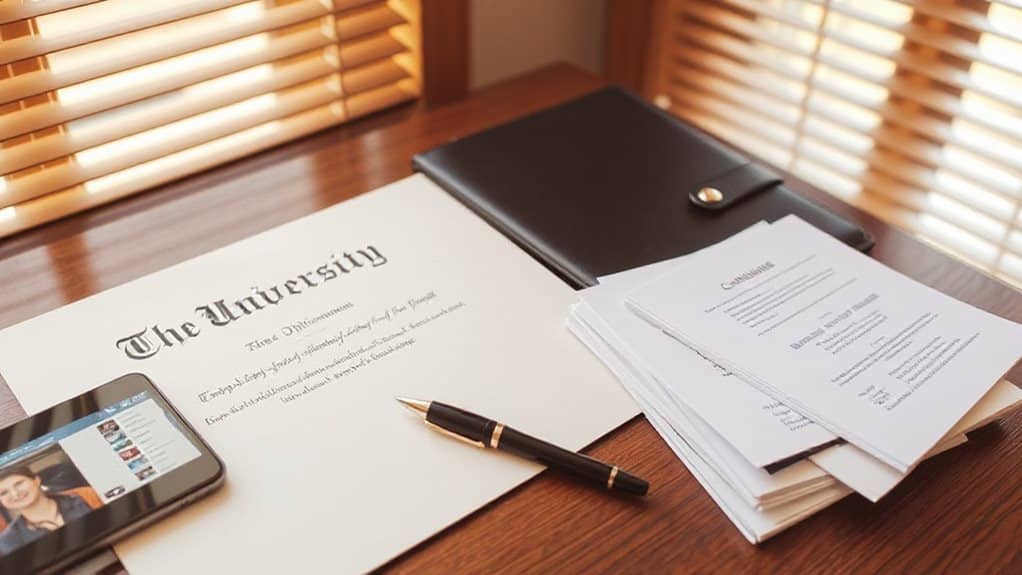
Before you walk into that interview room, you’ll want to have your original academic transcripts and certified degree certificates organized and ready to present, since Australian employers can and do verify your educational background through direct contact with institutions.
Have you gathered at least two forms of photo identification, such as your passport or driver’s licence, along with any name change documentation if your credentials don’t match your current legal name?
Taking the time to prepare these documents now shows professionalism and ensure you’re not scrambling for paperwork when opportunity knocks.
Original Academic Transcripts
Since employers in Australia will almost certainly ask to see your academic transcripts during the document gathering phase, you’ll want to track down your original records before that first interview even gets scheduled. Your transcripts verify enrollment, graduation dates, GPA, and course marks, confirming the foundational knowledge you’re bringing to serve others. Have you contacted your institutions yet?
Certified Degree Certificates
How prepared are you to prove that hard-earned qualification when an employer asks for it? You’ll need certified copies of your degree certificates, which serve as trusted alternatives to bulky originals. These copies, authenticated directly with your issuing institution, must accompany your transcripts for complete evaluation.
Employers verify the accreditation of your university, ensuring your credentials meet Australia’s rigorous standards.
Identification Documents Ready
Where exactly do you start when an employer asks to verify who you are? Gather your driver’s licence, passport, or proof of age card as primary ID. You’ll also need your birth certificate, Medicare card, or a utilities bill showing your current address. Having these ready shows you’re organized, respectful of their time, and serious about serving your future team well.
And Finally
You’re now equipped to handle education checks with confidence, aren’t you? By understanding your rights under privacy law, preparing your documents early, and knowing how verification actually works, you’ve turned a stressful process into a manageable step. Whether your degree came from Sydney or overseas, transparency and organization are your strongest assets. So take a deep breath, gather those transcripts, and step forward—you’ve got this. Your credentials tell your story, and you’re ready to share it professionally.

Emma Anderson is a professional executive resume and creative writer. She founded JobFrog Resumes in 2015 after leaving full-time work to raise her first child, combining her two passions: working from home with her family, and helping people put their best selves forward on paper. Emma has personally written every JobFrog resume since — no outsourcing, no templates — and stands behind the Jobfrog Rewrite Guarantee.