
AI is changing the Australian job terrain by automating routine tasks, which means some roles in sectors like property, finance, and legal services may decrease, leading to potential job displacement. However, new opportunities are emerging in fields such as AI training, data analysis, and ethics, requiring you to develop new skills. Staying competitive involves continuous learning, especially in soft skills like creativity and emotional intelligence. To better understand how you can adapt, keep exploring strategies to future-proof your career.
TLDR
- AI automation may displace routine roles in sectors like property services, finance, and legal assistance.
- New job opportunities will emerge in AI-related fields such as data analysis, ethics, and AI training.
- Workers need continuous reskilling, focusing on digital skills and soft skills like creativity and emotional intelligence.
- Human-centered skills like empathy and strategic thinking remain vital and less susceptible to AI replacement.
- Adapting through education and upskilling is essential for job security amid rapid technological change.
How AI Is Disrupting Jobs in Australia and What You Can Do About It

Although AI is rapidly changing industries across Australia, its impact on jobs is particularly significant, especially in roles involving routine and repetitive tasks.
As an Australian worker, you face potential job displacement due to automation.
To thrive in the future of work, focus on skills development and reskilling, which can help you adapt and remain *essential* in a changing job market.
Continuous learning contributes AU$41 billion annually to Australia’s GDP.
Which Sectors and Roles Are Most Affected by AI and Automation
AI and automation are revolutionizing various sectors in Australia at an unparalleled pace, and some industries are experiencing more significant impacts than others.
Sectors like property services, finance, and business are most affected, with roles involving routine tasks, such as data entry and legal assistance, facing high AI exposure.
Many professional occupations, especially in science and IT, are also vulnerable to job displacement.
AI-driven recruitment tools are increasingly used to screen resumes and manage early-stage hiring processes.
How AI Is Creating New Job Opportunities and Growth Areas

As AI continues to grow, it creates new job opportunities that require human skills like oversight, strategic thinking, and technical proficiency, which are essential for managing these advanced systems.
You might find yourself exploring roles such as AI trainers, ethics specialists, or data analysts, as demand for these positions increases across industries.
Isn’t it encouraging to see AI driving innovation and opening up these promising growth areas, balancing out the routine tasks that are being automated?
Employers and recruiters also value demonstrated stability and measurable impact on resumes, so highlighting quantified results and consistent timelines can improve your job prospects.
Emerging AI Careers
With the rapid advancement of artificial intelligence, new career opportunities are emerging across industries, reshaping the job environment in ways that can benefit those willing to serve others.
You can investigate AI careers like data analysts and AI trainers, or become ethics specialists focused on responsible AI. These emerging roles offer new opportunities to contribute positively while adapting to a changing world.
New Industry Sectors
Have you noticed how industries like finance, healthcare, and public administration are shifting due to advances in technology?
AI deployment and digital transformation are opening new roles in sector growth, such as AI integration and automation oversight.
These emerging industry sectors create opportunities for you to serve others by gaining specialized skills that support innovation and improve services.
Skills to Stay Competitive in an AI-Driven Job Market
Staying competitive in an AI-driven job market requires more than just technical knowledge; it calls for developing a diverse set of skills that are less susceptible to automation.
As an Australian worker, you should focus on AI skills, soft skills like creativity and emotional intelligence, and continuous reskilling or upskilling.
These future-proof skills can help you embrace others and secure your career.
Employers also expect awareness of workplace health and safety requirements and relevant industry certifications to demonstrate compliance and reliability.
How Education and Reskilling Prepare You for Future Careers

As technology continues to evolve rapidly, education and reskilling become essential tools for preparing you for future careers in an AI-driven job market.
By focusing on upskilling in digital-first roles and developing soft skills like creativity and emotional intelligence, you can stay future-proof.
Continuous learning and adapting educational pathways help you serve others effectively in an ever-changing environment.
The rise of online learning and microcredentials is expanding accessible, stackable pathways for rapid upskilling and employer-aligned training.
Jobs Less Likely to Be Replaced by AI: Where Human Skills Shine
Your ability to connect with others through empathy and emotional intelligence remains a key skill that AI can’t easily replicate, making roles like healthcare, teaching, or social work more secure.
Creative and strategic skills, such as original thinking in art, design, or problem-solving, also stand out as areas where human input is essential.
Do you see how these uniquely human qualities can give you an advantage in the developing job market, even with increasing automation?
Empathy and Emotional Intelligence
While artificial intelligence continues to advance and automate many technical tasks, jobs that rely heavily on empathy and emotional intelligence remain largely resistant to automation.
Your soft skills, like empathy and interpersonal skills, promote human connection, making you crucial in AI-proof roles.
Developing emotional intelligence is key for future-proofing your career, ensuring you excel in fields where genuine understanding and compassion are essential.
Creative and Strategic Skills
In a world increasingly driven by automation, jobs that demand deep creativity, strategic skills, and complex problem-solving stand out as areas where human skills continue to excel.
Your ability to apply creativity, emotional intelligence, and human-centered design makes you uniquely suited for roles like marketing, storytelling, and negotiation, where soft skills and subtle judgment are essential.
This ensures your value remains indispensable in the evolving workplace.
Practical Strategies to Adapt Your Career to AI Trends
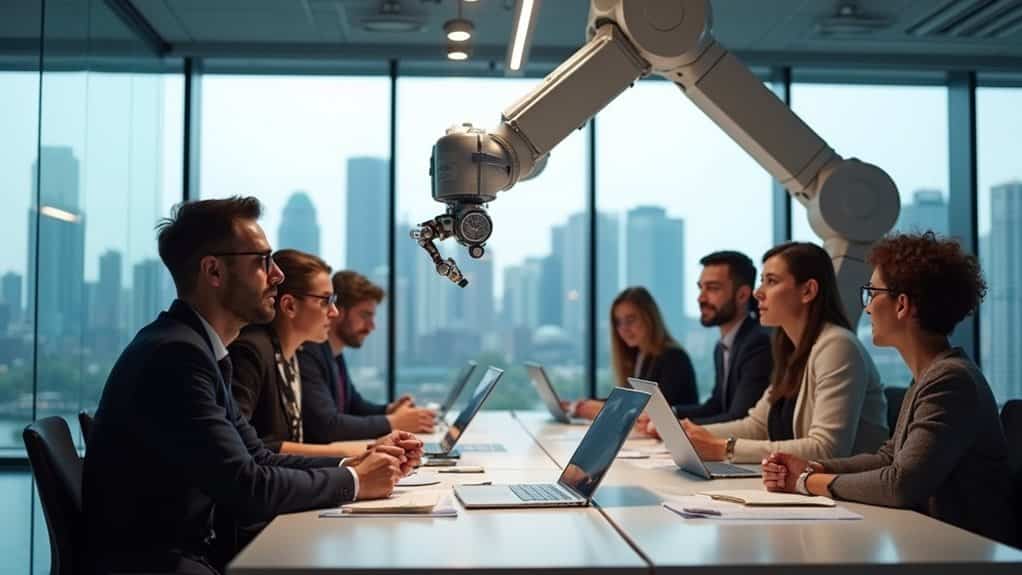
Adapting your career to AI trends requires proactive planning and a willingness to learn new skills, especially as the Australian job market rapidly evolves.
Focus on reskilling in AI skills like data analysis, embracing continuous learning, and developing soft skills such as emotional intelligence.
This adaptation helps guarantee future-proof career stability and resilience, making you more essential in a competitive, AI-influenced workplace.
Why Human Skills Like Creativity and Emotional Intelligence Matter
As automation and AI continue to advance, human skills like creativity and emotional intelligence become increasingly essential in the workplace. These soft skills are AI-proof because they involve subtle judgment and interpersonal interactions.
Developing your emotional awareness and creative problem-solving abilities helps you stay important, especially in roles requiring empathy, complex decision-making, or personalized service that AI can’t easily replicate.
Next Steps: Future-Proof Your Career in an AI World

To future-proof your career in an AI-driven world, you need to focus on developing soft skills like creativity, emotional intelligence, and strategic thinking, which are less susceptible to automation.
Adopt continuous learning and reskilling, stay informed about AI trends, and adjust to role evolution by building in-demand skills.
Your adaptability and commitment to serving others will keep you resilient.
And Finally
As AI continues to evolve, staying informed and adaptable is essential for your career. By developing skills that complement technology, such as creativity, emotional intelligence, and critical thinking, you can remain important in the job market. Consider reskilling and embracing new opportunities in growing sectors. Will you take proactive steps today to future-proof your career? Remember, your ability to adapt will determine your success in an increasingly automated world.

Emma Anderson is a professional executive resume and creative writer. She founded JobFrog Resumes in 2015 after leaving full-time work to raise her first child, combining her two passions: working from home with her family, and helping people put their best selves forward on paper. Emma has personally written every JobFrog resume since — no outsourcing, no templates — and stands behind the Jobfrog Rewrite Guarantee.